
ASC TAKES FLIGHT: PUBLIC ART TRANSFORMS CHARLOTTE DOUGLAS INTERNATIONAL AIRPORT
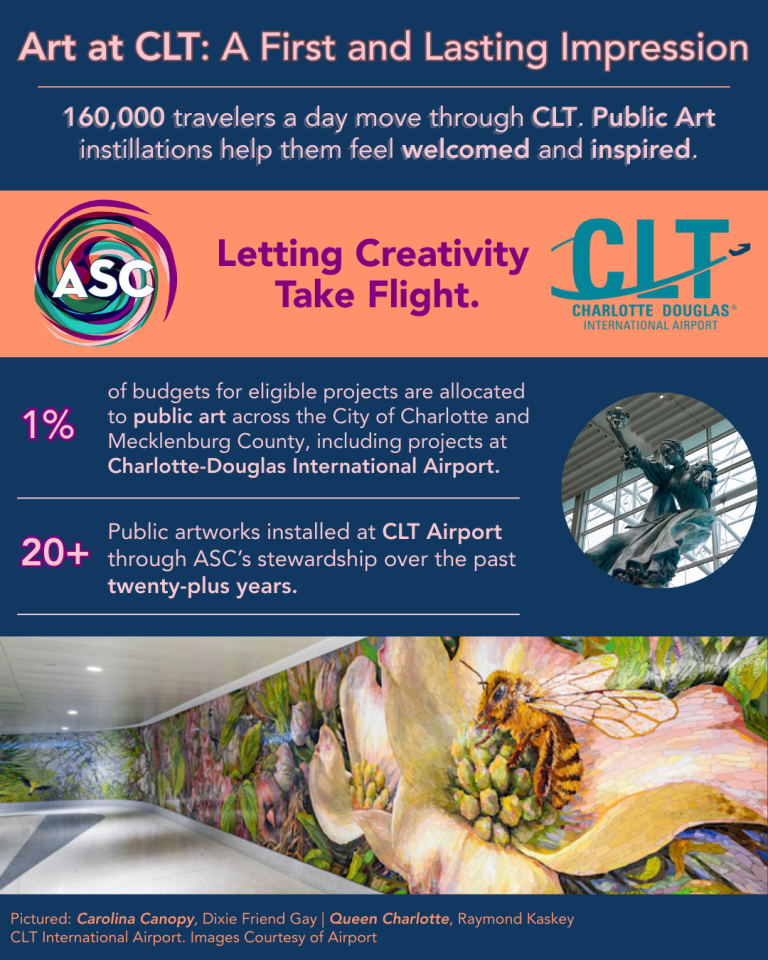
Every day, on average, about 160,000 people pass through Charlotte-Douglas International Airport.
And close to 70% of those passengers see nothing more of the Queen City than the inside of our airport, which Lauri Golden calls “the portal to our city for the millions who are here just long enough to make a connecting flight.”
Golden, who’s worked at the airport since 2007, is CLT’s customer engagement manager. She and her team aim to ensure that travelers — even those who are here for a short time — come away with a positive impression.
“When you’re in an airport, you’re generally trying to get from one plane to the next,” Golden said. “You may have just 20 minutes. You may have two hours. You may have all day.”
No matter how long or short your duration inside CLT, Golden wants it to be a good experience, and public art is a big contributor to that. That’s where ASC comes in.
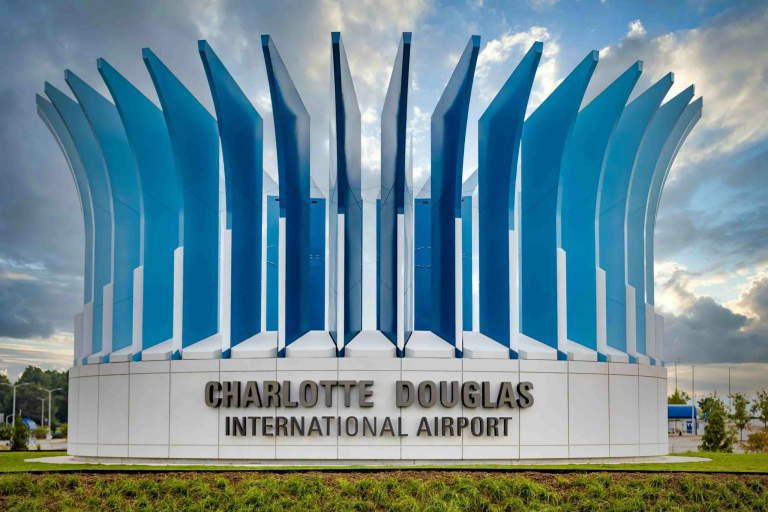
When an Airport Becomes a Canvas
“Charlotte-Douglas has an amazing art program, thanks to the city of Charlotte’s 1% percent for art ordinance,” said Todd Stewart who, along with his team, manages that program while working closely with Golden. (Stewart was referring to the Mecklenburg County Commissioners and the Charlotte City Council ordinances that appropriate 1% of eligible capital improvement project funds for public art.)
“With each capital improvement project,” he said, “my team asks: How can we integrate the artwork so that it feels like part of the built environment rather than something tacked on?”
The art installed at the airport (see it on CLT’s website here) has to do some heavy lifting.
Not only is it designed to spark joy in weary travelers; it’s also got to leave a powerful first impression of Charlotte. Stewart said, “The airport is many people’s first impression of the city. For travelers just connecting here, the airport gives them a glimpse of our culture.”
Improvements are being made to the airport all the time. Unlike other construction projects that are, sooner or later, finished, construction at the airport seems eternal. (There’s even a page on the airport’s website devoted just to construction.)
“If you’ve lived in Charlotte for any amount of time, you’ve experienced the ongoing construction at our airport,” Golden said. “We’re always working to enhance the airport experience, and we know construction is a pain point for visitors.”
Golden and her team try to minimize the impact construction has on visitors.
When construction alters pathways frequent flyers know well, for instance, airport staff will work all hours to help guide people. Golden said, “I’ll never forget working an early shift, and a woman walking past me at about 5 a.m. and saying, ‘I came early just to see the new art.’”
A grand welcome
ASC led the public art planning and artist selection process for the terminal lobby expansion — the largest capital improvement program in airport history.
What’s known as the “pre-security lobby” — which includes everything before the TSA check — has been expanded into one massive, but unified, space. The project began in 2019 and was just completed in September 2025, with the final artwork placed in January 2026. During those years, 8 works were selected, completed and installed.
Artwork elsewhere in CLT is seen by only the people headed for that particular terminal. But art in the pre-security lobby has the potential to be seen by everyone who comes to the airport. That’s an honor — and an opportunity — for artists.
“These are very competitive commissions,” Stewart said. “CLT is such an amazing venue given the thousands of people who travel through it daily.”
Artists are given creative license in proposing work for the airport, although Stewart asks them to consider the site.
“The task I give every artist,” he said, “is to think about being as specific to the site as possible. Some look outside the walls of the airport … to let travelers glean a little bit about Charlotte as a region. Others depict what happens within the airport walls. And some speak to flight and travel, and they all do that in beautiful ways.”
For instance:
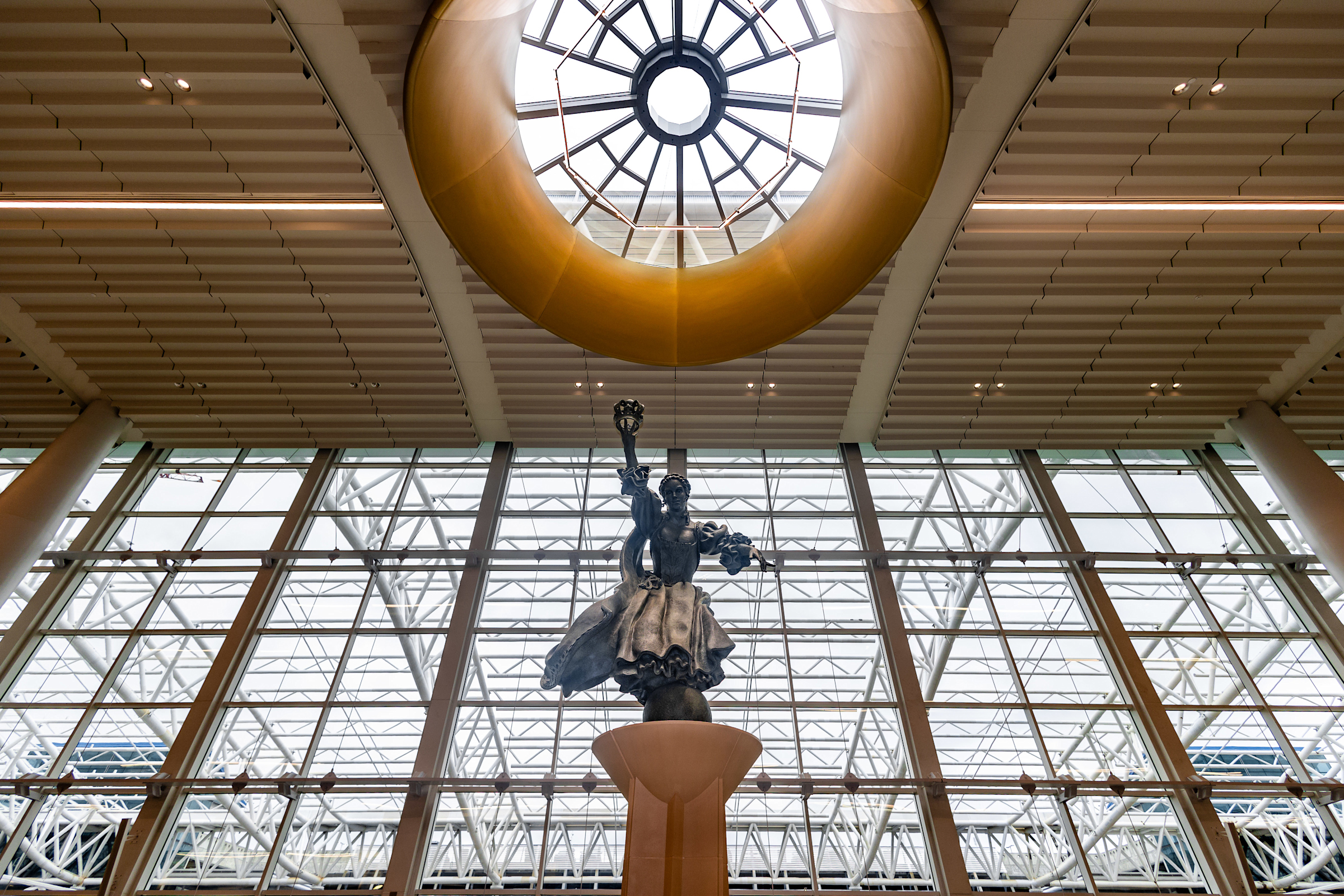
- Washington, D.C.-based Raymond Kaskey created the iconic, 15-foot-high bronze Queen Charlotte sculpture, which was previously outside between parking decks. The sculpture, originally dedicated in 1990, had a new patina put on by Carolina Bronze Sculpture before being moved inside and placed on a newly designed plinth by Kaskey, becoming the centerpiece of the new lobby.
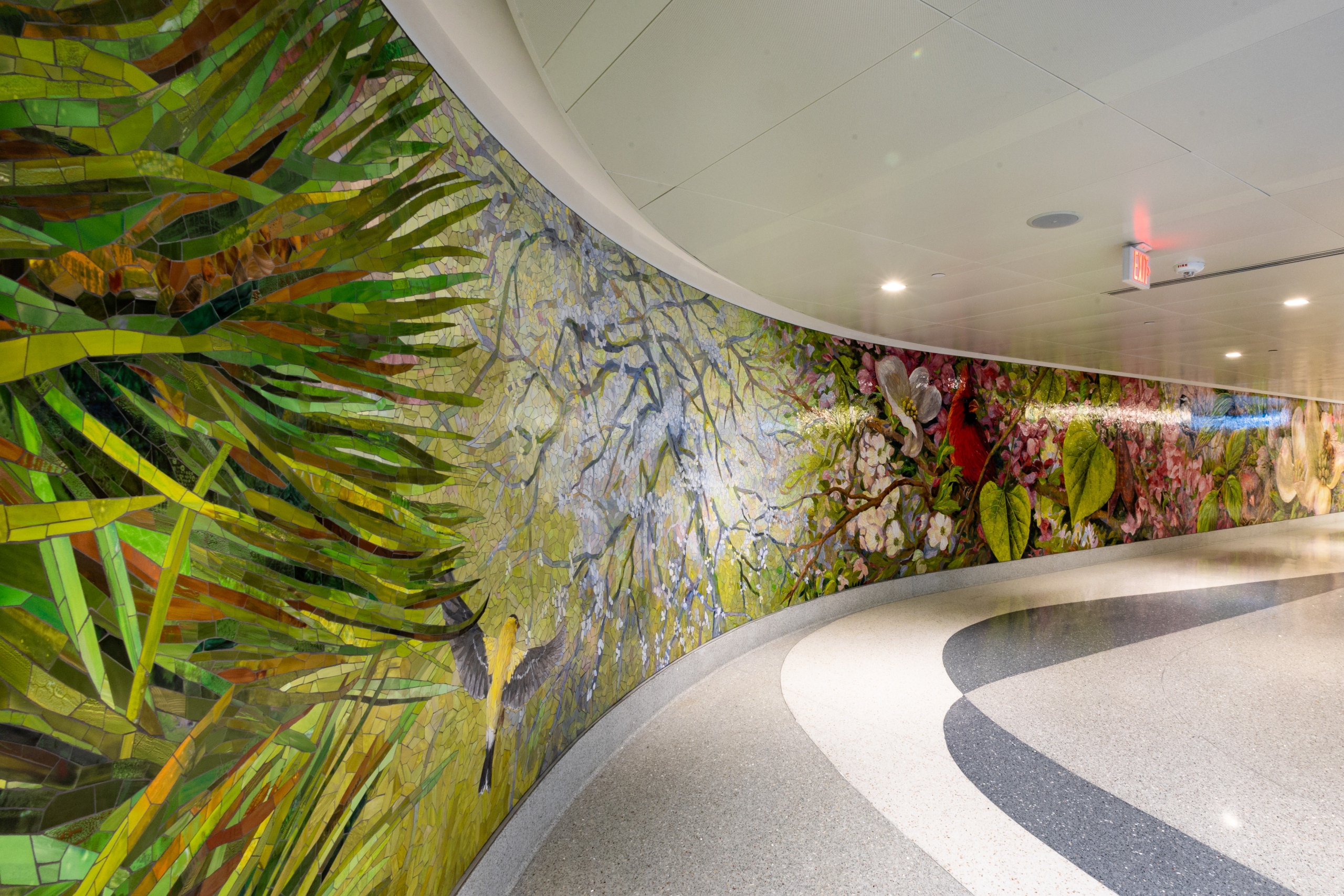
- Dixie Friend Gay‘s Carolina Canopy, a mosaic for the international arrival wall, “has received glowing feedback,” Stewart said. There’s a lot more to this colorful work than meets the eye. The artist did meticulous research that included interviewing botanists. Each tile was hand-glazed and hand-placed in a painstaking process.
- Queen Charlotte is “flanked by two beautiful, suspended sculptures by Danielle Roney in the East and West Wings,” Stewart said. They’re collectively known as Meridian. The casual observer may just glance up and notice something ethereal overhead. But the piece is actually an impressive combination of art and science. It relates to flight paths of departing and arriving traffic, and Roney used actual airport data to create the patterns.
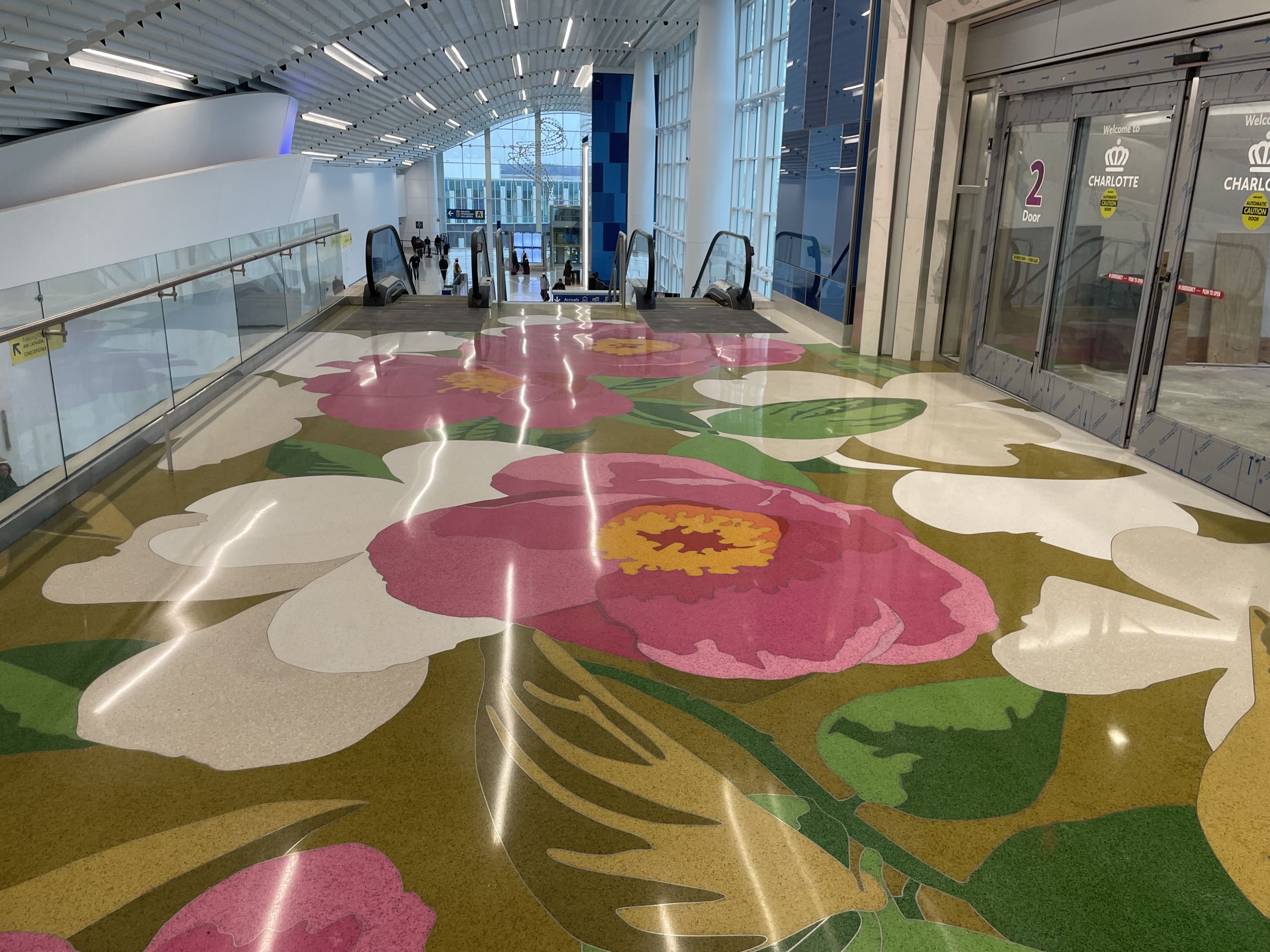
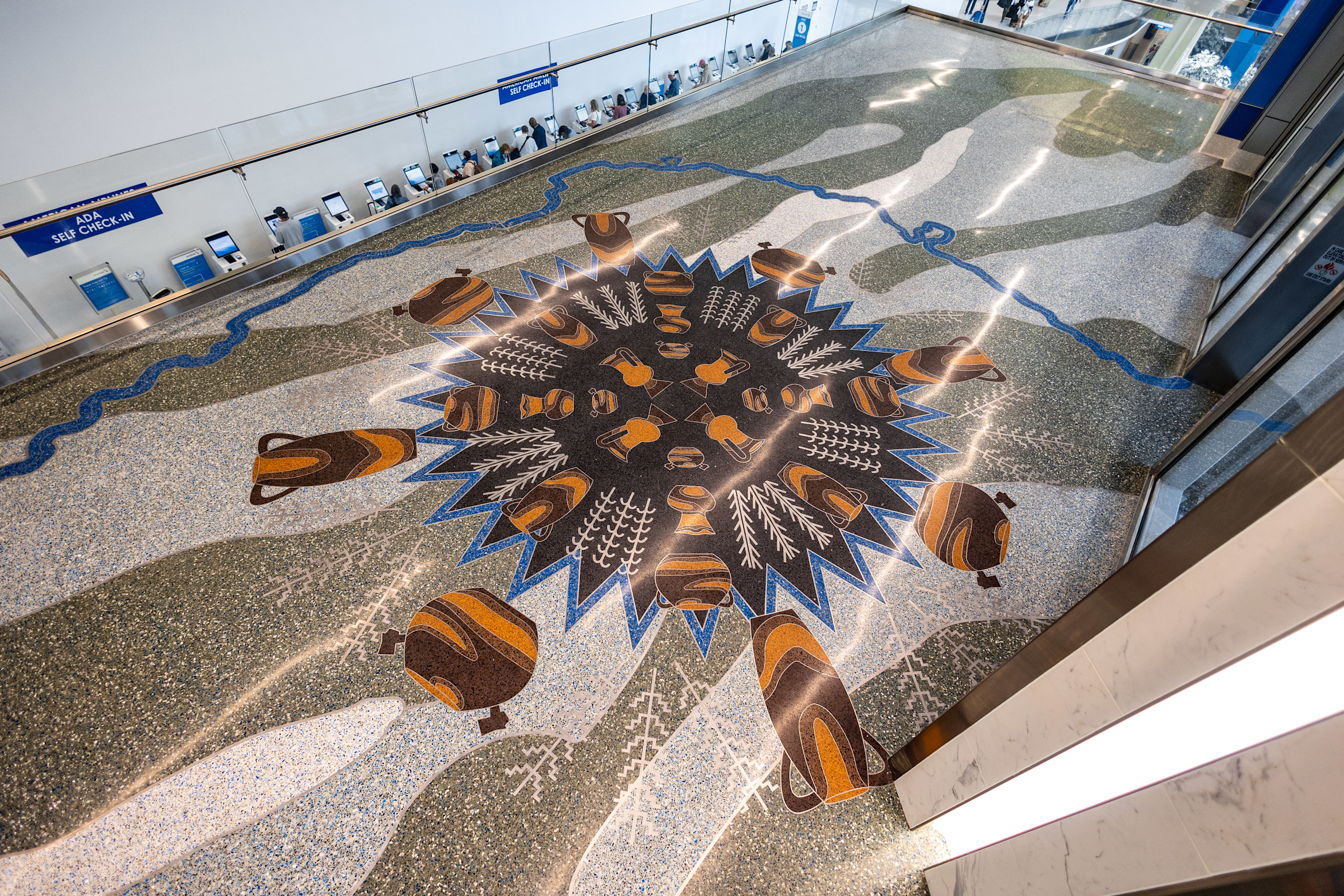
- “Two beautiful terrazzo floor pieces were designed by artists for specific mezzanines,” Stewart said. Susan Brenner created Garden Carpet, a terrazzo floor piece made up of oversized blossoms for the West Mezzanine Skybridge. The counterpart to “Garden Carpet” in the East Mezzanine is Janelle Stanley‘s Catawba Ways. Stanley is a First Nations artist who worked with the Catawba nation to create what Stewart calls “a beautiful mandala of their historic cultural pottery traditions.”
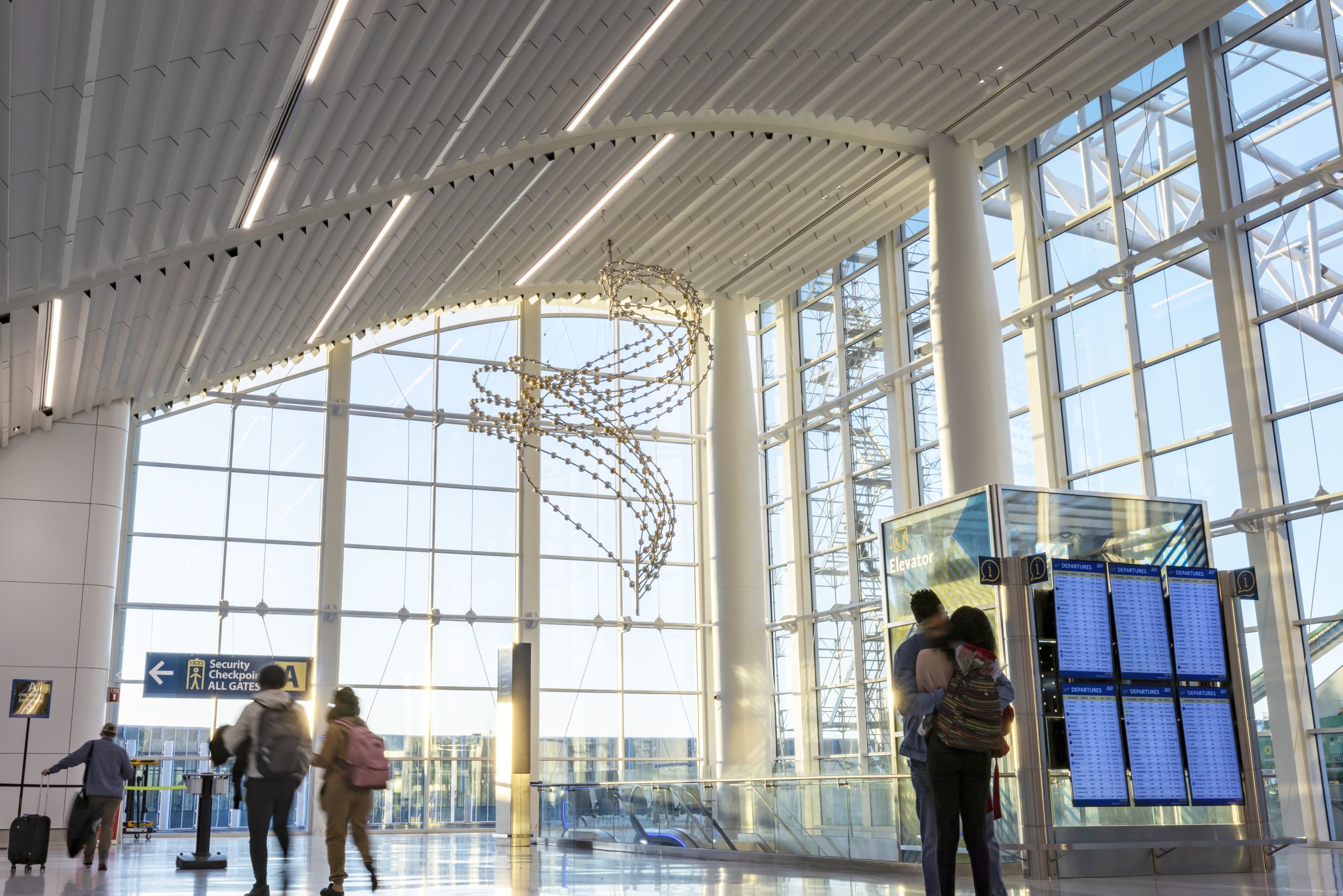
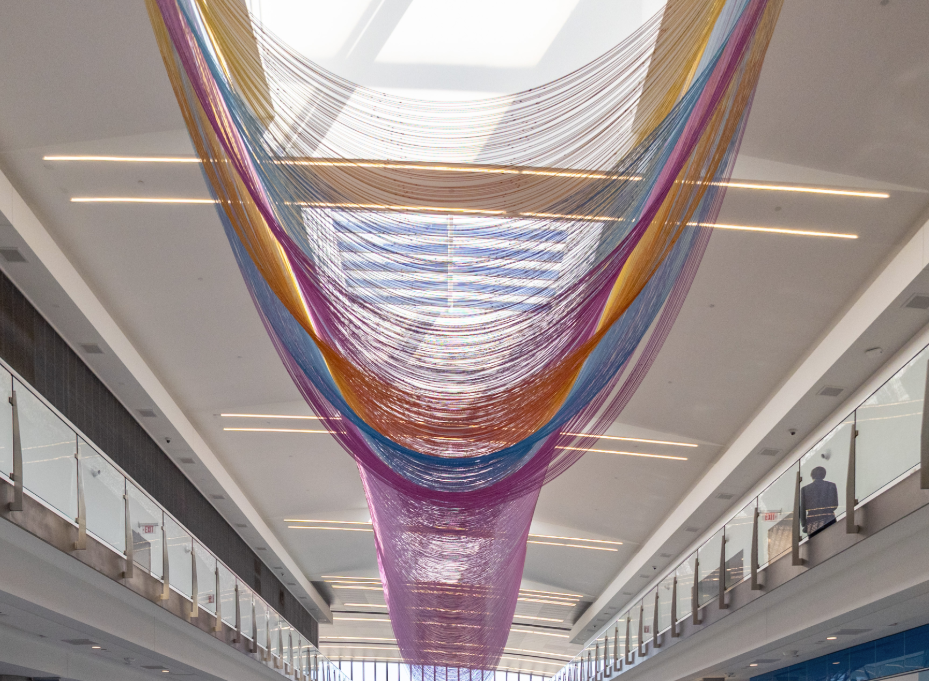
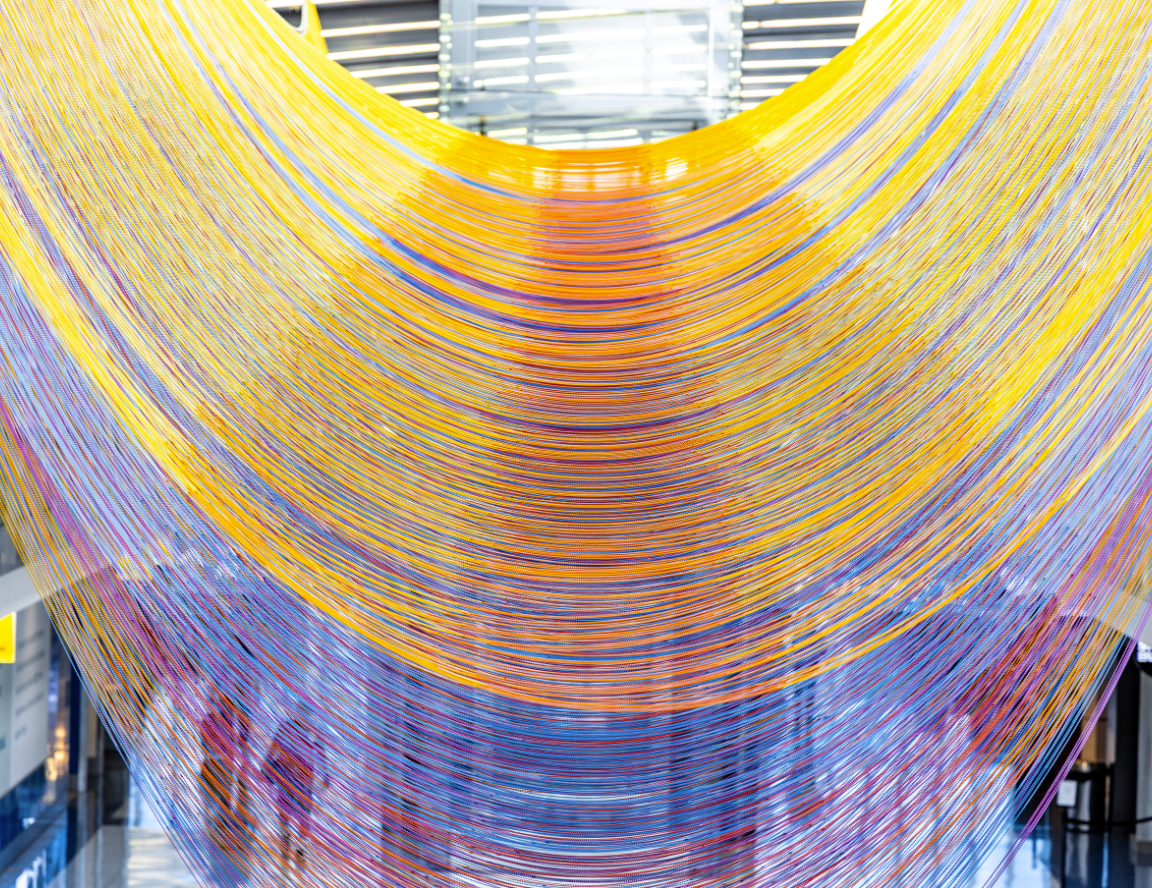
Additional projects (pictured below) recently completed at Charlotte Douglas International Airport include an artwork that invites visitors to direct their gaze to the skies, or at least the clerestory ceiling Concourse A. Weightless Monument, Benjamin Ball‘s 90-foot suspension of stainless steel ball chain, gently sways and dances with the soft glow of nearby windows.
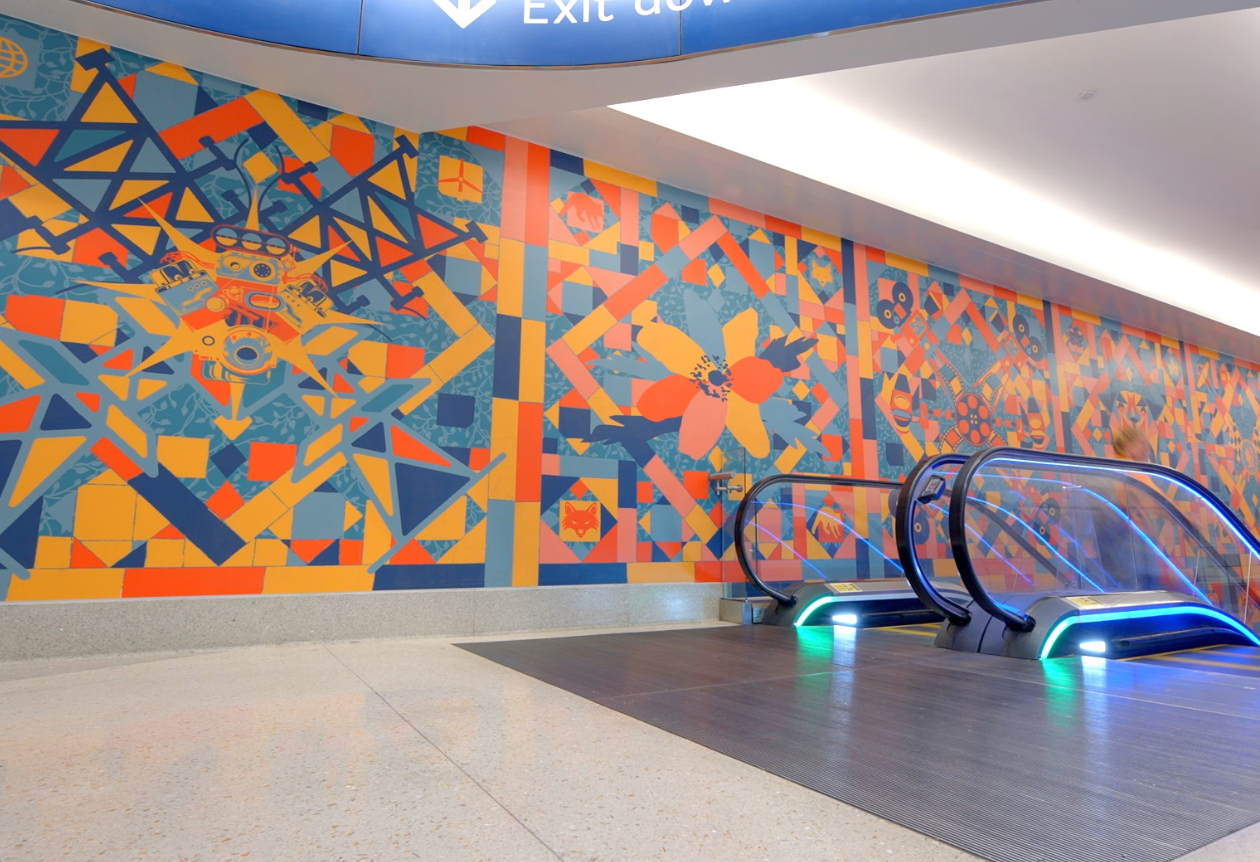
At Domestic Arrivals, airport visitors are treated to the work of Nigerian-born, Brooklyn-based artist Olalekan “LEk” Jeyifous.‘ His creation, Nurture and Nature, an engaging collection of boldly hued geometric patterns is representative of Charlotte’s diverse and growing business industries and regional, native flora and fauna. Known for addressing social themes through his art, Jeyifous says this piece does more than just “solve spatial challenges,” as he told the Airport.
ART, EVERYWHERE YOU LOOK
Just because the terminal lobby project has been completed doesn’t mean construction at the airport has stopped. Or that the last art installation has been placed.
The modernization of Concourse D, a major hub for international travel, began in early 2025 and will be completed later this year. Look for new seating with charging stations, refreshed restrooms, updated lighting and improved traffic flow.
The art in CLT contributes mightily to Charlotte’s status as North Carolina’s public art powerhouse. But it also has the potential to elevate Charlotte in the minds of travelers just passing through.
On a recent trip to New York, Stewart flew into LaGuardia, which Forbes named the country’s best airport in 2024 and 2025. Looking at the art, he thought CLT really measured up. “I would put us on the same level when it comes to the amount of forethought, planning and integration of our works into the airport,” he said. “I think we’re leaders in that regard.”
Learn more about public art on ASC’s website, artsandscience.org and see photos of some of the works ASC has helped bring to life.
And consider “Becoming a Dream Maker,” and give to ASC. When you support the Arts & Science Council, you help Charlotte-Mecklenburg serve as North Carolina’s public art powerhouse.
ABOUT ASC
The Arts & Science Council (ASC) is Charlotte-Mecklenburg’s cultural leader, serving as a resource hub, funder, and advocate for arts, science, and history.
A supporting organization of Foundation For The Carolinas, ASC champions local creatives by investing in the arts, sciences, and culture to drive economic growth, community retention, and cultural engagement.
Our mission is to build inclusive, sustainable, and culturally rich communities where creativity drives belonging, growth, and opportunity. From artist support grants and public art stewardship to free Culture Blocks events and partnerships with local schools and universities, ASC invests in a thriving, accessible creative ecosystem for all.